
Why the pressure drops
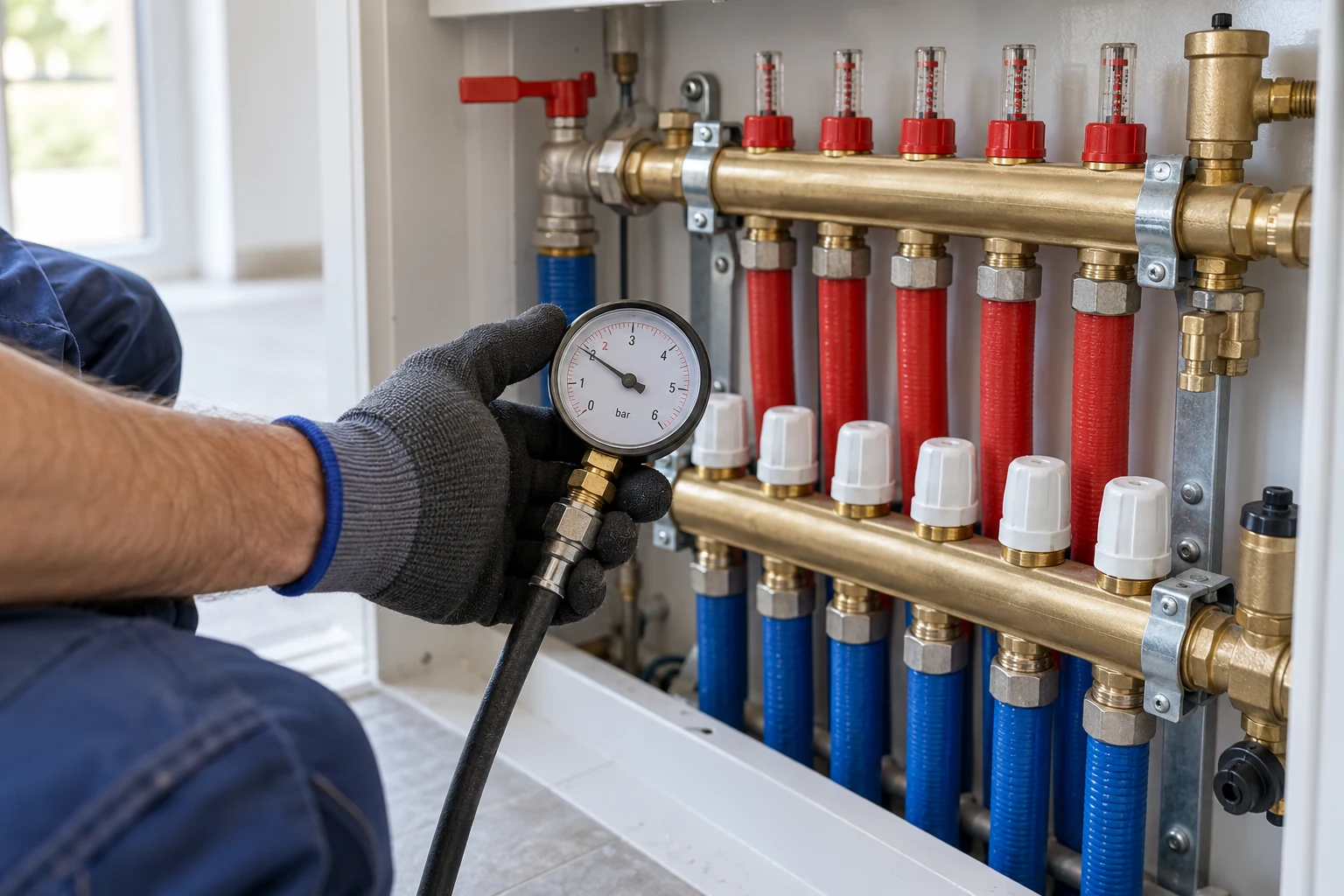
A pressure drop may indicate a loss of coolant, but it does not always mean a leak in a hidden pipe. The cause is also checked in the operation of the expansion tank, the safety valve, the boiler and the system connections.
Pressure gauge readings also depend on the temperature of the heat carrier. So for comparison it is important to consider whether the system is heated or has cooled down. Acceptable values should be checked in the equipment manual and with regard to the specifics of the particular system.
Where to look for visible traces of water
Inspect the accessible connections near radiators, manifolds and pipes, as well as the areas around the equipment. Drops, damp patches, signs of corrosion or deposits at joints may indicate a leak.
Water sometimes runs away from the damage along the pipe, so the place where a stain appears does not always match the location of the leak. On hot surfaces, a small amount of water can evaporate without leaving a noticeable puddle.
How the problem section is identified
If the system is divided into separate branches or circuits and has suitable shut-off valves, the specialist can check them separately. For this, the system diagram, access to the valves, and working pressure measuring tools are important.
A pressure gauge shows pressure only in the part of the system it is connected to. The test results depend on valve positions, temperature and the connection method. Work on the boiler and fittings should be entrusted to a qualified specialist.
How a hidden leak is found
When pipes run inside a wall or under the floor, the damage location is not always visible. The inspection may use a thermal imager, a moisture meter, an acoustic device or the tracer-gas method. The choice depends on the pipe material, access conditions and the state of the system.
A thermal image shows the distribution of surface temperature. By itself it does not prove a leak: heating may be related to a pipe running there or to other factors. That is why readings are compared with other signs and, if necessary, additional measurements.
If the pressure keeps dropping
Note how quickly the readings change and under what conditions this happens. Tell the specialist whether there is underfloor heating, where the accessible pipes run and whether stains appear. This will help plan the check.
Do not dismantle the boiler or change the safety equipment settings yourself. If there are signs of a boiler fault, contact a service specialist; to find a hidden leak, a separate pipeline survey can be arranged.